
Home › Learn & Trade › Trader Foundations › Risk Management in Trading
Trader Foundations
Risk Management in Trading: How Much Should You Risk Per Trade?
Risk management is the part of trading that decides how much a wrong decision can cost you. Learn how to size positions, control drawdown, manage leverage and survive losing streaks without turning a normal trading loss into an account-threatening event.
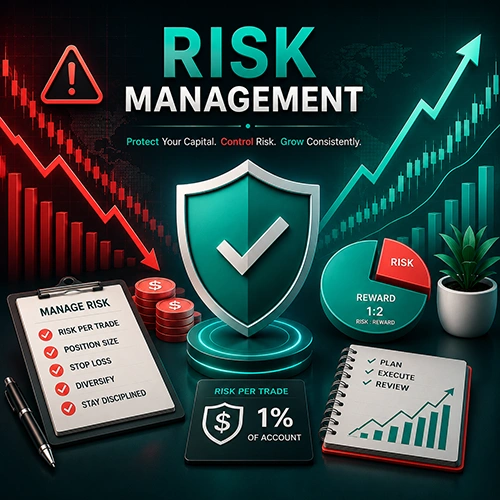
If you read our article on why most traders lose money, the next question is obvious: how do you protect your account while you are still learning? Risk management is the framework that answers it. It does not turn a losing strategy into a profitable one, but it can stop a temporary setback from becoming a permanent loss of trading capital.
What You Will Learn:
Table of Contents:
- What Is Risk Management in Trading?
- How Much Should You Risk Per Trade?
- Position Sizing: The Part Many Traders Get Wrong
- Stop Loss and Risk: They Are Connected, But Not Identical
- Leverage, Margin and Actual Risk
- Drawdown: The Number Every Trader Should Understand
- What Happens During a Losing Streak?
- Risk Management Beyond a Single Trade
- A Practical Risk Management Framework
- Common Risk Management Mistakes
- Risk Management is Not a Profit Strategy
- Frequently Asked Questions
- Sources and Further Reading
What Is Risk Management in Trading?
Trading risk management is the process of deciding, before entering a trade, how much capital you are willing to lose and how that loss fits into your wider trading plan. It includes position sizing, stop-loss decisions, leverage, maximum exposure, daily loss limits and drawdown rules.
The key idea is simple: your position size should be determined by the amount you are willing to lose, not by the amount you hope to make.
A useful mental model: Your strategy answers “Where should I trade?” Risk management answers “How much can I afford to be wrong?”
1
Define the loss
Set a maximum monetary or percentage risk before the order is placed.
2
Size the position
Adjust the lot or share size to match the chosen risk and stop distance.
3
Control exposure
Limit simultaneous positions, correlated trades and daily account losses.
How Much Should You Risk Per Trade?
There is no universal percentage appropriate for every trader, strategy or account. A conservative framework often starts with a small fraction of account equity, such as 0.5% to 1% per trade, and then evaluates whether the strategy and trader can tolerate the resulting drawdowns.
The important part is consistency. Risking 0.5% on one trade, 4% on the next and 8% after a loss is not a risk-management system. It is changing the rules when emotions are highest.
| Account | 0.5% risk | 1% risk | 2% risk |
|---|---|---|---|
| $1,000 | $5 | $10 | $20 |
| $5,000 | $25 | $50 | $100 |
| $10,000 | $50 | $100 | $200 |
| $25,000 | $125 | $250 | $500 |
| $50,000 | $250 | $500 | $1,000 |
These figures are examples of percentage risk, not a recommendation that every trader should use those levels. Your financial situation, strategy, volatility, trading frequency and ability to tolerate losses all matter.
Position Sizing: The Part Many Traders Get Wrong
Position sizing connects your trading idea to your actual financial risk. Suppose a trader has a $10,000 account and decides that the maximum loss on a trade should be $100. The stop-loss distance then determines how much can be traded.
Position Size = Amount at Risk ÷ (Stop Distance × Value per Unit of Movement)
For Forex trading, a simplified version is:
Lot Size = Risk Amount ÷ (Stop-Loss Pips × Pip Value per Lot)
Example: A $10,000 account risks 1%, so the maximum planned loss is $100. If a EUR/USD trade has a 50-pip stop and the broker’s quoted pip value is approximately $10 per standard lot, the illustrative position size is:
$100 ÷ (50 × $10) = 0.20 standard lots
The exact pip value depends on the currency pair, contract size, account currency and exchange rate, so this is an illustration rather than a universal lot-size rule.
Notice what happened: the stop became wider, but the position became smaller. Risk management does not require every trade to have the same stop distance; it requires the financial risk to remain controlled.
Stop Loss and Risk: They Are Connected, But Not Identical
A stop-loss order is an exit mechanism. Risk management is the larger system that determines how much exposure you take in the first place. A stop does not automatically make a position safe.
For example, risking $500 on a $10,000 account with a tight stop is still a 5% planned loss if the stop is reached. A wider stop can be compatible with a smaller account risk if the position size is reduced accordingly.
Important: Stop orders do not guarantee an exact execution price in all market conditions. Gaps, fast markets and liquidity conditions can cause the actual fill to differ from the stop price. Investor.gov explains that a stop order becomes a market order once its stop price is reached.
Why Leverage Can Make Risk Harder to See
Leverage allows a relatively small amount of margin to support a much larger position. That can be useful, but it also magnifies the effect of adverse price movements relative to the capital committed as margin. Investor.gov and the CFTC warn that leverage can amplify losses and that leveraged forex trading can result in substantial losses. Investor.gov forex guidance and the CFTC forex advisory provide additional investor education.
Leverage
How large a position you can control relative to your margin or capital.
Position size
How much of the instrument you actually trade.
Trade risk
How much money you expect to lose if your predefined exit is reached.
A trader can have high available leverage and still use a small position with controlled risk. The opposite is also possible: modest leverage does not prevent excessive risk if the position is too large.
Drawdown: The Number Every Trader Should Understand
Drawdown measures the decline from an account’s previous peak to a subsequent low. The percentage gain required to recover becomes larger as the loss increases.
| Account loss | 0.5% risk | Gain required to recover |
|---|---|---|
| 5% | $9,500 | 5.26% |
| 10% | $9,000 | 11.11% |
| 20% | $8,000 | 25.00% |
| 30% | $7,000 | 42.86% |
| 40% | $6,000 | 66.67% |
| 50% | $5,000 | 100.00% |
This is why “I can make it back quickly” can be dangerous after a major loss. A 50% drawdown requires a 100% gain from the remaining capital to return to the starting balance.
What Happens During a Losing Streak?
A sound risk model should be designed for losing trades before the losing streak happens. Even a strategy with a genuine statistical edge can produce clusters of losses.
| Risk per trade | # of consecutive losses | Approx. capital remaining |
|---|---|---|
| 0.5% | 10 losses | 95.10% |
| 1.0% | 10 losses | 90.40% |
| 2.0% | 10 losses | 81.70% |
| 5.0% | 10 losses | 59.90% |
| 10.0% | 10 losses | 34.90% |
These figures assume each loss is exactly the stated percentage of the current balance and ignore costs, slippage and other real-world effects. They illustrate compounding drawdown rather than predict actual results.
Risk Management Beyond a Single Trade
Managing individual trades is only the first layer. A trader can risk 1% per position and still create excessive portfolio-level exposure by opening several highly correlated trades.
Maximum risk per trade
Maximum daily loss
Maximum simultaneous exposure
Correlation between positions
Maximum account drawdown
Rules for reducing risk
Correlation matters
EUR/USD, GBP/USD and AUD/USD are different pairs, but several positions can still express the same broad USD view. Treating every trade as completely independent can underestimate portfolio exposure.
Set a daily loss limit
A daily loss limit can prevent a difficult session from becoming an emotional trading marathon. Once the predefined threshold is reached, trading stops for the day rather than shifting into recovery mode.
A Practical Risk Management Framework
Choose a fixed risk budget.
Decide the maximum percentage or monetary amount you are willing to risk on a normal trade.
Define the invalidation point.
Decide where the original trade idea is no longer valid before entering.
Calculate the position size.
Use the risk amount and stop distance to determine the position, rather than choosing the lot size first.
Check total exposure.
Look at existing positions, correlated pairs and open risk before adding another trade.
Respect the daily limit.
If the maximum daily loss is reached, stop trading instead of trying to recover it immediately.
Review drawdown rules.
Define when you will reduce position size or pause trading after a significant account decline.
Common Risk Management Mistakes
1
Risking more after a loss
Increasing risk because the next trade “has to win” turns a statistical process into a recovery attempt. The market does not know what happened on the previous trade.
2
Choosing the lot size first
“I always trade 0.50 lots” is not a risk-management rule. The same lot size can represent very different monetary risk when the stop distance, instrument or account size changes.
3
Moving the stop farther away
Moving a stop simply to avoid taking the planned loss changes the original risk calculation. If the market has invalidated the trade idea, delaying the exit can turn a controlled loss into a much larger one.
4
Ignoring trading costs
Spread, commission, financing and other transaction costs reduce trading results. Investor.gov notes that forex transaction costs can affect profitability and that “commission-free” does not necessarily mean cost-free trading.
5
Treating every open trade as independent
Several trades can be expressions of the same market view. Portfolio exposure should be considered alongside the risk of each individual position.
6
Changing risk emotionally
Risk rules should be written before trading. Increasing size after a winning streak or a losing streak can make account volatility much higher than the trader intended.
Risk Management is Not a Profit Strategy
This distinction matters. Risk management can control the size of losses, but it cannot create positive trading expectancy.
A strategy that loses money over a sufficiently large sample will still lose money with excellent position sizing. The value of risk management is that it can keep losses contained long enough for a genuinely positive strategy to operate through normal variance.
Think of risk management as survival infrastructure. Your strategy needs an edge; your risk model determines whether you can stay in the game long enough to find out whether that edge is real.
f.a.q.
You have questions. We have answers.
These answers provide general educational information and should not be treated as personal financial advice.
There is no universally safe percentage. One percent is a conservative example, not a universal rule. The appropriate level depends on the strategy, account, trading frequency and the trader’s tolerance for drawdown.
Consistency is generally easier to control and evaluate than changing risk emotionally. Systems may vary risk for volatility or portfolio exposure, but those adjustments should be predefined.
No. Fast markets, gaps and liquidity conditions can cause slippage. Broker rules and order types also differ.
No. Available leverage and actual risk are different concepts. The problem is using leverage to support positions that are too large relative to the account. Regulators warn that leverage can amplify gains and losses.
A strong starting point is to know the maximum acceptable loss before entering and size the position accordingly. Then control aggregate exposure and drawdown as well.
Sources and Further Reading
join us!
Need More Help?
Successful trading isn’t about luck. It’s about having the right mindset, knowledge, and tools. Start your journey today.
Risk notice:
Forex and CFD trading involves substantial risk. This article is educational and does not provide personalized investment advice or guarantee trading results.
 to be a light for all traders.